
Tag Archives: W&E
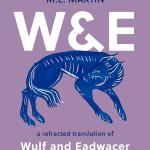
Translation as Relation: Form, Silence, and Creative Reimagining in M. L. Martin’s “W&E, a refracted translation of Wulf and Eadwacer”
M. L. Martin’s “W&E” is a radical translation of the mysterious Anglo-Saxon poem “Wulf and Eadwacer.” The original is a very short yet highly ambiguous Old English poem, preserved only in the Exeter Codex, a manuscript dating to around the tenth century. Martin’s “W&E” belongs to the same lineage as Anne Carson’s “Nox,” where translation is experimented radically across genres and language, blending poetry, memory, visual arts, and fragmented syntax to embody the multiplicity in sensibility and meaning.