
Nathan Dize & Laëtitia Saint-Loubert
In this interview, editors Nathan H. Dize and Laëtitia Saint-Loubert discuss the transoceanic dialogues Ananda Devi facilitates in her fiction, poetry, and translations between French, English, and Mauritian Creole.
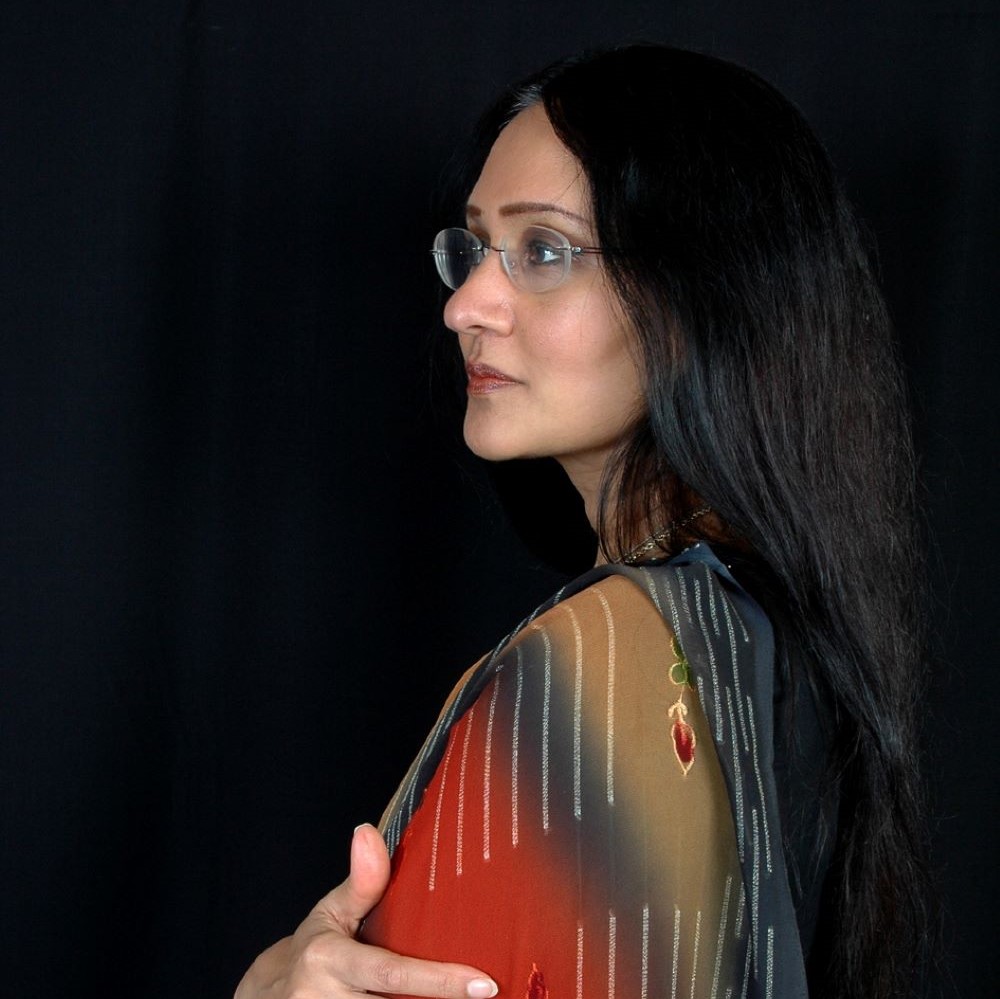
Nathan Dize & Laëtitia Saint-Loubert (ND & LSL): Translation is part of your literary practice, both in your work with other authors’ texts and in your own self-translations. How do you understand the relationship between writing and translating in your work?
Ananda Devi (AD): My first experience in literary translation was when I was asked by Dapper publications to translate The Counting House, a novel by the Guyanese writer, David Dabydeen, into French. It is a very powerful novel about a country with a colonial history very similar to that of Mauritius, despite the discrepancy in size between the two countries. I therefore understood it at a very deep level and was fascinated by the choices David made in telling that story. But when I came to the final part of the novel, written entirely in Guyanese English, I realized that this represented an almost incommensurable challenge: Guyanese English, despite having its own specificity, was understandable to anglophone readers, perhaps in the same way that Salman Rushdie’s Hinglish passages were. However, Mauritian Creole had evolved quite differently, to the extent that, although its etymology is mainly derived from the French language, it is not directly understandable by French speakers. I couldn’t therefore simply transpose Guyanese English into Mauritian Creole (which would not have made sense in any case, as the cultural references were quite different). I thus needed to deconstruct and reconstruct the language in order to convey the music, the rhythms and the syntax.
To be honest, I don’t think I was successful. I would have needed much more time to achieve this. I would have had to invent a language. I actually achieved this much better in my own novel, La vie de Joséphin le fou, written a few years later, and it is only now that I wonder whether my experience translating The Counting House hadn’t led me to the language used in Joséphin…
In addition to the fact that I was unhappy with my own translation of this novel, I was also unhappy with the French title, Terres maudites, chosen by the publisher. The Counting House is a powerful and coldly cruel title, evocative of the economics of slavery and indentureship that undermined the displaced humans as mere commodities. The French title was a kind of judgement on the two countries, India and Guyana, where the novel took place. It wasn’t the lands that were maudites but the people exploiting them for commercial gains. This was a disheartening beginning to my translation work!
More importantly, I realized that, during the whole time I was engaged in this work, I could not easily go back to my own writing. Dabydeen’s voice is a strong one in which I had immersed myself so wholly that I found it difficult to go back to my own voice in between working on the translation. I felt conflicted, unsure whether what I was writing was coming from myself or was bleeding from another writer’s voice. After I completed the translation, I decided that I wouldn’t translate other writers’ work, as I needed to preserve that mental space for myself. But as I still needed to get a job, I applied for a job as a translator of scientific and technical texts with the World Intellectual Property Organization in Geneva. Although it was a steep learning curve, it was immediately clear to me that I could translate these texts all day long, and still come back home and work on my own writing with no interference between the two. It was as if different parts of my brain were engaged in the two processes, just as I could write Rue la Poudrière in French while writing my PhD. thesis in English.
This was a perfect combination, despite the fact that I was basically working full-time as a translator and writing full-time as well. I ventured again into literary translation with my own novels, Rue la Poudrière (that I never published) and Pagli (published in India), and later on with the poetry collection Ceux du large. Recently, I translated a prose poetry book by Kazim Ali, and enjoyed it very much despite the difficulties of translating such an intricate, delicate and extraordinary book. I think I have overcome the obstacles I encountered when translating The Counting House, and am able to immerse myself in another writer’s voice without feeling that it prevents my own from emerging.
ND & LSL: You have translated from English into French and have also translated your own writing, originally produced in French, at times into English, as was the case with Pagli (Gallimard, 2001), as you mentioned, and at others into Mauritian Creole – as with Ceux du large (Bruno Doucey, 2017), a trilingual collection of poems that also includes English. Do these different forms of translation engage different creative processes for you? Could you tell us more about how you experience self-translation and how it interacts with your “mother tongue,” insofar as you consider this notion meaningful?
AD: When I wrote Pagli, I felt I had touched a deep fibre that gave this novel its specific poetical tone, beyond the fictional context. It was the first novel I wrote in which I gave myself the freedom to go back and forth between prose and poetry. This freedom was heady, and the final chapters of Pagli were written with an equal amount of emotion and pleasure. When I began to rewrite it in English, I heard the narrator’s voice, her rhythms, her moods, outside language, so to speak. As a music inside my head that I could play with different instruments. I began to write the English version of Pagli, not for any external reader, but for myself. The novel slipped from French into English without my intentions being changed, at least ostensibly.
I knew that I was allowing myself considerable freedom with the translation. I would read a passage and rewrite it, letting the original be a guide that I more or less followed, but also listening to the music of the English text, so that when the sounds pulled me towards different images, I would allow them to do so. I realized that this happened most often in those passages where the writing was more overtly poetic. In the same way as my poetry writing in French relies on the sound of words, on alliterations and echoes, different images were created by the transposition to the English language, even if the tone and the mood were the same. Nevertheless, this was not a different novel or even a changed one. Or at least, I believe it wasn’t.
Moreover, in many places, I felt that the French was overly lyrical and the sentence structure too heavy for a faithful rendering in English. It didn’t read well in English, to put it simply. I therefore cut sentences up, removed certain adjectives, and towards the end, played down, or so I feel, some of the lyricism present in the French text.
Another area of change that I allowed myself was self-revision: since I was working on the translation a couple of years after writing the original, there were passages that I felt less happy with upon rereading them, and the English rewriting gave me the opportunity to make corrections that I would have made anyway if I had allowed the text to rest in a drawer and had taken it up again after a few years. In other words, the English version was a continuation of a work in progress which all literary works would remain if they were not fixed by the publication process.
But I have to point out here one of the fascinating conundrums that translation and cultural context generate: this has to do with the title of the book. The French title is Pagli. The English title is Pagli. What could be more simple? No change at all – no translational act in this. But culturally, and in terms of intention, it is another matter altogether. The novel acquired its title almost from the first moment of writing. When the novel was published, the French publisher did not try to change it. Pagli is a hindi word meaning “madwoman”. In Mauritius, it is often used pejoratively in the masculine form – pagla –, to describe someone who is not really mad but is acting in a crazy way. It’s somewhat equivalent to the word loco. My use of it as the title of a novel published in France was of course not innocent. This was a novel where I had also used Creole chapter headings and Creole dialogues, refusing the publisher’s request to have footnotes or a glossary at the end because the translation or explanation was contained in the text itself, and the Creole was understandable from the context. I wanted the title to sound “foreign” to the French reader and the novel to require from the French reader some kind of effort or at least participation in understanding it, an effort that would be contrary to the exoticisation that is often seen in earlier novels written in former colonies. In a way, Pagli was a novel written in French but requiring an effort of translation from the French reader because Creole is after all part of French history, the history of slavery. This language arose from the need for communication between the African slaves and the French masters. Why should the French readers not try to understand a language that was born out of the savagery of their own historical legacy?
When the English translation was to be published in India, the question of the title was posed in a different way. In India, the word pagli is not only familiar and easily understood, and in that sense, not at all mysterious, it is also a kind of cliché. In Bollywood movies, the word has been used in innumerable songs. Many scantily clad, singing and dancing heroines would be called pagli, meaning “crazily in love”. There was thus a risk that the title of the novel would convey something completely different and false to the Indian reader – as if I had called the novel in French “la folle”, or worse, in English, “The madwoman in the attic”!
In the end, I didn’t change the title. So what if the meaning and understanding and impact of the title changed from country to country? Thinking back, the title of the French novel, when read in Mauritius, would also have been familiar and somewhat clichéd. The title of the English novel would still sound foreign to a reader in England and even more so in the United States. In Italy, the translator called the novel Pagli – Pazza, giving the translation in the title itself, with a pleasant alliteration. In Spanish, the title remained Pagli. Writing itself, and all writing from a colonial historical context, is after all an act of translation.
As for the poetry collection Ceux du large, the genesis was quite different. I had just written a series of poems in French about migration and the crossing of the seas that is so deeply entrenched in my DNA as in that of all Mauritians. I was thinking of the middle passage, the transport of hundreds of thousands of indentured laborers from India, as well as, in our times, the tens of thousands of migrants drowned in the Mediterranean Sea or dying as they cross borders. How migration is a constant in the settlement of all countries and regions of the world, but with such different consequences, depending on which side of the continuum of dominance one is.
I was then invited for a book tour in the US to promote the publication of my novel Eve de ses décombres/Eve Out of Her Ruins in English (translated by Jeffrey Zuckerman). This was in 2016, during the electoral campaign that would lead to Donald Trump’s first presidency. Listening to his speeches, I was flabbergasted by the rhetoric of hate that spewed from his mouth. I saw how this was a turning point: the racism that was carefully kept hidden in political discourse was being openly advocated in front of wildly approving crowds. An almost incoherent old white man was clamoring for even more of the dominance that has been entrenched by centuries of colonial and neo-colonial rule. (With the benefit of hindsight, I know that the version I was seeing then, and that horrified me, was nothing compared to the one currently wreaking havoc on the world, but what do you know?). Hearing him talk about the shithole countries of the world, seeing the way the Black Lives Matter or the #MeToo movements were being turned on their heads to create a backlash against woke and feminism, I felt a real fear for the future, which has only been confirmed, ten years on.
Since my American publisher was based in Texas and wanted me to give talks in Houston and Austin, I began to think that my poems about migrants would have a different resonance and a different relevance there, especially as Trump promised to build a wall between the US and Mexico. With a sense of urgency, I started to translate the yet unpublished poems into English, with the intention of reading them during the tour. At night, in my hotel room, plagued by the sleeplessness of jetlag, I worked on this rewriting, which could only be that – not a translation, but a rewriting. This ping-ponged back onto the French, with changes being made in both versions while I was writing the English one. I did read them in public during that stay in the US. I remember a woman in Houston patiently explaining to me that the country was a pie, and that there were only so many pieces of the pie to share (she meant with foreigners). To which I replied that, considering that 1% of the population owned the majority of the wealth and resources, the division of the pie was skewed from the start.
When I came back home, I completed the rewrite. And it then occurred to me that I had three languages, not two, and that I shouldn’t stop there. If I wanted to be true to my own hybridity, I had to write these poems in Creole as well. And so I embarked on a second rewriting, which again ping-ponged on the other two, so that in the end, I don’t really know whether the French could be called the “original” language of these poems.
The most telling difference, unlike Pagli, is in the three titles. These came to me without prompting or thinking, in the subconscious way in which poetry generally comes to me. The French title is Ceux du large. The English, Afloat. The Creole, Bann noye. A strange progression. The French evokes people coming from afar, in a suspension that promises neither life nor death. They are all the others who are held in the limbo of otherness. The English has, to my mind, a kind of hopefulness, since, while at sea, they are still floating and they are, in a way, buoyant. As for the Creole title, it is the complete opposite: it means the drowned. No ambiguity, no uncertainty, no hope. It puzzled me, if I am honest. Why was I being so harsh in this language? What was the impulse behind this title? I realized upon reflection that this was because the Creole language itself is the heritage of the drowned. The enslaved who litter the Indian Ocean and the Atlantic Ocean, and whose remains will never be found. A language born of an uncompromising violence and cruelty. This title harked back to the very roots of the language. Bann noye. An entire history in two words.
ND & LSL: Translating into Creole can raise particular questions about readership, literary norms, and publishing infrastructures. What does it mean for you to bring texts into Mauritian Creole?
AD: It is a sad fact that the readership in the Creole language is extremely limited. Not just because it is a language that is spoken by relatively few people worldwide, and Creole languages that have similar historical origins but have evolved in different geographical situations (Mauritius, Réunion, Seychelles, Haiti, Martinique, Guadeloupe, etc.) are not readily intelligible between these countries. But also because those who speak the language in their everyday life are often the first, at least in Mauritius, to say that they cannot read it. This is due to the fact that the accepted spelling moves away from the French etymology towards a more phonetic one. Qui becomes ki, moi becomes mwa, casser becomes kase etc. This was the only way in which a syntactical and orthographic coherence could be achieved. However, despite the simple correspondences between the phonetic spelling and the spoken language, many Mauritians say that they cannot read Creole. The language only began to be taught in schools about fifteen years ago. And even then, it was an optional subject, often chosen by the pupils belonging to what is called the Creole community, i.e. those of African or Malagasy descent. And so, a language spoken by the majority of Mauritians is only studied by a minority of students.
A political movement was required to begin to create a Mauritian literature in Creole…
ND & LSL: More broadly, what role can translation play in sustaining or expanding the literary presence of Creole languages?
AD: Translation is absolutely essential. It is not only for Creole languages but also, of course, for the world literary heritage. This is the only way we can transcend languages to make literary creations accessible to the widest possible audience. However, only a small proportion of books are translated and read, which is heart-breaking when you think of the extraordinary work produced worldwide. In addition, artificial intelligence is making the work of translators even more precarious than before. Literary translation has always been notoriously undervalued and underpaid. If publishers now decide to use AI instead of human translators, we will find ourselves in a situation where only the most commercially successful work will be translated, as the more challenging literary work will pose difficulties even to sophisticated AIs. I dread to imagine their attempt to translate poetry!
Creole-language books are accessible to a tiny readership, even in those countries where Creole is spoken. The political movement I mentioned above began to publish books in Creole, including by the Mauritian writer Lindsey Collen. But very few Mauritians will buy these books in a bookshop. This language is still considered a subaltern language, not worth investing in for the future of children whose parents dream of their becoming doctors or lawyers or following some money-making profession. On the contrary, the majority of Mauritian parents feel that learning Creole at school has absolutely no value and is a dead-end. The prestige of the two colonial languages, English and French, still holds an absolute sway, nearly sixty years after independence. Learning other ancestral languages is a means of maintaining distinct identities, even if they may not be spoken at home. But Creole is paradoxical in that Mauritians feel a deep connection to it and yet do not see it as prestigious enough to be worth investing in.
For younger generations to be inspired to write in Creole, they must have access to a literary corpus in this language. This corpus is at the present time still very small. The Collection Maurice, an anthology published each year, features short-stories written by different Mauritian writers in the three languages, Creole, French and English. The collection was created thirty years ago, and it is interesting to see that the contributions in Creole have increased from year to year. I have myself contributed to it since its creation (I have a text in 29 of the 30 books), mainly in French, but also occasionally in English and in Creole. I am also the president of the jury for a poetry competition in all three languages, the Prix de poésie Edouard Maunick. The members of the jury have seen that, over the years, the submissions in English and Creole have become more numerous than those in French, whereas at the beginning it was the opposite, and the quality of the submissions has also changed, with those in English and Creole becoming much more interesting that those in French. It is thus even more important that the literary corpus in Creole should become larger for Mauritian children to be inspired to write in this language. For this, publishers need to be ready to invest in it and to make a concerted effort to encourage children to read in Creole from a very young age. This is as yet far from the case.
ND & LSL: The circulation of literature remains deeply shaped by publishing markets and institutional gatekeeping. As a writer and translator, how have you experienced these dynamics?
AD: Being a sexagenarian who started writing before the age of computers and internet and instant global communication, who sent my manuscripts by post to major French publishers and waited several weeks before receiving polite or contrite rejection letters, I am fully aware of the inequalities in the publishing system. My books were published first in Mauritius, then in Abidjan (Nouvelles Editions Africaines), then by l’Harmattan (the military service of Francophone writers, we used to joke among ourselves), before slowly making their way to the major publishers, Gallimard and Grasset. Although I became known in Mauritius from a young age, I somehow couldn’t be totally accepted until I had forged this publication path. About fifteen years ago, I attended a literary festival in Durban, Time of the Writer, where we had a “parliament session” in the actual Durban parliament to discuss the future of African literature and publication. Although there were a number of publishers throughout the continent, we agreed that the major problem was distribution. This was the key to the commercial market hogged by Western publishers. Without a distribution system, books published in African countries would be limited to a tiny readership within each country, and were not even available in other countries of the continent. This was the point I raised at the “parliament”, saying that it was not really a publication but a distribution problem, and that perhaps South Africa could become a hub to make African authors’ books available, not only within the continent, but worldwide. Unfortunately, this has never been a priority for any of the decision-makers, and it never came to be. Nowadays, even in France, there is a major take-over of publishers by huge distribution groups such as Hachette Group which is part of an even bigger conglomerate headed by Vincent Bolloré, a right-wing magnate. Independent publishers and bookshops are being strangled, as the cultural sector becomes a prey to an ever-hungry financial system ready to devour everything that comes within its grasp. The prix unique du livre – i.e. the decree that a book being sold at the same price in France, whether it is in bookshops, supermarkets or online – prevented the wholesale destruction of bookshops that took place in the US as a result of huge differences in price. This law, promulgated in 1981 by Jack Lang, when Amazon didn’t exist yet, was a safeguard that allowed bookshops to survive in France. Even the advent of Amazon could not challenge the law: Amazon cannot sell books published in France at a discount, and even the loophole it found in offering free postage was closed when it was deemed to be unlawful. Yet, this law can do nothing against the take-over of the distribution system by conglomerates. Capitalism will always find a way to triumph.
When we see how even the richer countries that may want to protect the independence of the cultural sector cannot do anything against the financial system, it is even more ludicrous to think that a small country such as Mauritius will find a way to protect its writers. The same applies to the far bigger, but still poorer countries of the African continent. Everything is being swept up in this drive for profit that a form of uber capitalism has launched in this century. The billionaires (and now trillionnaires) forming an oligarchic technocracy belong to a generation that sees money as the ultimate objective. They have no moral compass, no principles, no altruism. In order to reach this pinnacle, they had to be prepared to manger l’autre, to quote the title of one of my novels, in other words to devour the weak. They are the peak of the food chain. Then we have the “traditional” power players: the magnates that run the banking system, fossil fuel industry, the arms industry, pharmaceutical corporations, and industrial conglomerates. And then the factor that we could perhaps not foresee: politicians who seem to be cut from the same cloth, white (or whitish), almost geriatric, narcissistic and egocentric males, ready to wage war and sow chaos for whatever convoluted reason their mind will come up with, the epitome of whom is Donald Trump. But Benjamin Netanyahu, Vladimir Putin and Narendra Modi are not far behind him. All of them thrive on far-right ideologies. All of them intend to crush the poor and the weak, not even to enslave them, as during colonial times, but to destroy them wholesale. To make them redundant, to push them into destructive conflicts or to imprison them in camps by means that echo those utilized by Nazi Germany. We are living in the age of fascism, and exhibiting the same passivity as the Germans who said they did not know what was happening to the Jews. Except that we do know. We cannot say that we are not “informed”, although this word has now taken on a completely different meaning.
The trap is extraordinarily well-primed: it is in our own hands. It is our smartphone.
ND & lSL: In your view, how might translation challenge – or sometimes reproduce – the colonial hierarchies that structure global literary circulation?
AD: Re-reading my reply to the earlier question, I realize that it might be thought that I have moved away from the subject. But it is not the case. Translation is a concept that transcends time, space, and even language itself. We are in a constant state of flux, of change, of becoming, which is what the translational state is. Flux, change, becoming. We, as human beings, are translating ourselves into something else. But what is it? The industrial age has issued a different set of norms, something Karl Marx foresaw perhaps more clearly than we realize: when a human being becomes redundant, when machines are being actively primed to replace them, except for those that are at the top of the food chain. We can see the world disintegrating before our eyes, and we can do nothing to stop this wild careering towards the abyss. Even as I write this, I can imagine my being seen as a doomsayer, as a conspiracy theorist, in the same way as I see the antivaxx movement as conspiracy theorists. But at least I can ask myself whether they could be right. I can see both sides of the coin. I can interrogate my own prejudices. But can “they”? By “they,” I mean those who are so convinced that the reality they have conjured is the true one?
This is the reason why I have never joined any social media, even at the very beginning. Well, to be honest, at the very beginning, it was because I thought it would be too time-consuming without anything to gain from it: I was working full-time as a translator, I was writing, I was looking after my family, I was travelling to literary events, and I never took any holidays, basically. Facebook was far from a tempting opportunity! I imagined people wanting to be “friends” and being offended if I refused. I thus remained totally aloof from any social media, even being forced to join Instagram for a videoconference with an Indian journalist before opting out.
I can say that I have never regretted it. Perhaps I could have had more readers? But I am not even sure of that. I have seen the language of hate that emerged from the safety of anonymity. And how this created bubbles where people were enclosed with those who thought exactly as they did, and were thus never exposed to differing opinions. Judgement was swiftly passed. A lone clip could lead to devastation. Stars struggled to deal with the backlash after a thoughtless comment. And, of course, there was no privacy. So what could ever have tempted me to join?
I am truly grateful that I was born in an age without television, computers or the internet. I saw technology happening in front of my eyes. I measured the incommensurable power of being able to use a word processing application to correct my own writing ad infinitum. I loved the fact that I could communicate with other writers by email, engaging in long conversations and exchanges that made us grow as writers. I will never say that I regret the advent of technology. As a translator at the World Intellectual Property Organization, I translated patent applications that announced amazing developments, as well as rather scary ones.
It’s like the atomic bomb, isn’t it? For each amazing development, there would be one that had the potential to destroy. I also translated, horrified, a patent application from the US for a landmine shaped as a toy. Or one from China that proposed using human growth hormones to accelerate the growth of farmed animals and fish.
I am even more convinced now that literature is the place where we can see the world as it is, not as we want it to be. Books do not pull their punches. Despite the tendency for self-censorship, we are still, for some time at least, free to write what we want. It will not last. We should make the most of it. I am a sixty-nine-year-old woman who has looked at the world with, I believe, a kind of clarity and humanism. I would not wish to change this. I believe in literature as the last voice of truth. And translation is an essential partner in making this truth heard.
Born in 1957 in Mauritius, Ananda Devi is considered one of the major francophone literary voices. Published by the major French publishers Gallimard and Grasset, she has won numerous literary prizes and her work is studied in universities around the world, including the United States, UK, France, India and Poland. She has been translated in a dozen languages and has received decorations from Mauritius, with the title of Grand Officer of the Star and Key of the Indian Ocean, and from France, with the title of Officier des Arts et des Lettres. In 2014 she received a major award from the Académie Française. The University of Silesia, Poland, awarded her an honorary doctorate. In 2024. She was the recipient the prestigious Neustadt Prize in the United States for her body of work.
Nathan H. Dize is Assistant Professor of French at Washington University in Saint Louis. He is the author of Attending to the Dead: Haitian Literature and the Practice of Mourning. Nathan is also a translator of Haitian literature, including The Immortals and The Emperor by Makenzy Orcel, I Am Alive by Kettly Mars, Duels by Néhémy Dahomey, and Antoine of Gommiers by Lyonel Trouillot. He is also a founding member of Kwazman Vwa and the co-editor of “Global Black Writers in Translation” at Vanderbilt University Press.
Laëtitia Saint-Loubert is a literary translator specializing in Caribbean and Indian Ocean literature and a teaching fellow in Translation and Translation Studies at Nantes University, France. She holds a PhD in Caribbean Studies from the University of Warwick and was an Irish Research Council Postdoctoral Fellow at University College Dublin prior to joining Nantes University. Her first monograph, The Caribbean in Translation. Remapping Thresholds of Dislocation (Peter Lang, 2020), won the 2018 Peter Lang Young Scholars Award in Comparative Literature.