
Reviewed by Laëtitia Saint-Loubert

The recent publication of Jamaican writer Alecia McKenzie’s Marins désarmés/Unarmed Mariners (Vieux-Habitants, Guadeloupe: Atlantiques déchaînés, 2025) alongside Dominican poet Daniel Thaly’s Looting Hummingbirds (London & Trafalgar, Dominica: Papillote Press, 2026) offers an opportunity to reflect on contemporary Caribbean poetry’s engagements with mobility, memory, and translation. While distinct in form and emphasis, both collections are bilingual, pairing each source text with a parallel translation: McKenzie’s collection presents English poems alongside French translations by C. and S. Renard, whereas Thaly’s selected poems present French texts alongside English translations by Mark Andrews and Lizabeth Paravisini-Gebert, who also co-edited the volume.
Both collections participate in expanding Caribbean translation routes, as their publishers – whose distribution networks extend across the region and beyond – foreground island-to-island literary exchanges and transoceanic circulation. In doing so, these contributions interrogate and move beyond the enduring colonial logics that continue to structure literary production, from publishing markets and gatekeeping institutions to the mechanisms that determine which works circulate, in what languages, and for which audiences, thereby resisting the traditional metropolitan routes through which Caribbean texts continue to mainly travel. This commitment to regional circulation is further evidenced by a translation project between the two presses: the forthcoming French translation of Lennox Honychurch’s Resistance, Refuge, Revival: The Indigenous Kalinagos of Dominica (Papillote Press, 2024), due to appear in October 2026, as Atlantiques déchaînés recently announced on social media.[1] It therefore made all the more sense to consider together the two poetry collections selected for this review and this special issue of Reading in Translation dedicated to “Archipelagic Francospheres: Transoceanic Dialogues Through Translation.”
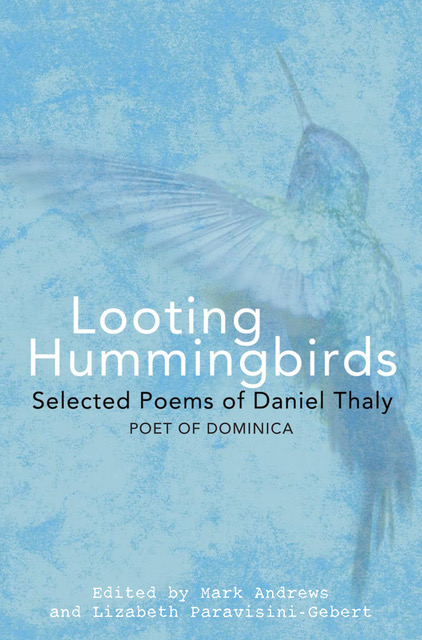
Framed by Lizabeth Paravisini-Gebert’s preface and Mark Andrews’s introduction, Looting Hummingbirds reads more like a critical edition than Marins désarmés/Unarmed Mariners. This is not to suggest, however, that the volume was intended solely for an academic audience. The paratext at the beginning of the book primarily serves to (re)contextualize Thaly’s work but also, as the preface indicates, to “rescue” the author’s work and “reintroduce him to the island that cradled his creative spirit” (Looting Hummingbirds 9). The volume presents translation as a means of recovering Thaly’s largely forgotten literary voice and remedying the long-standing absence of an English translation of his work, “including [in] his homeland of Dominica” (12). Mark Andrews’s introduction also engages with Thaly’s (contested) legacy, acknowledging that although he was once widely praised, he was later criticized for his affiliation with the mixed-race bourgeoisie of the French West Indies and “upbraided in particular for irrelevantly memorializing the indigenous Caribs of Martinique, exterminated in 1660, while ignoring rebellions of Black slaves” (25). As the book makes clear, however, the poet never intended his work to be political.
Thaly’s poetry evokes both the flora and fauna of his native Dominica and reflects on his divided identity, oscillating between Dominica and France, but also between Dominica and Martinique. It also dwells on his experience of loss following the 1902 eruption of Mount Pelée and its devastating impact on Saint-Pierre and Martinique more broadly. Thaly’s poetry might even be characterized as environmental poetry avant la lettre. Indeed, a number of his poems are devoted to endemic species, such as the “tam tam” and the “diablotin”. As Thaly himself laments: “What has become of you, O renowned diablotins? / […] Will you nevermore come to sow sparks / Over a sea afire with moonshine?”.[2]
In stylistic terms, his poems are deeply informed by Parnassian aesthetics, characterized by a chiseled, classical form and composed predominantly in alexandrines. In their Translators’ Note, however, Andrews and Paravisini-Gebert explain their decision to render the poems in free verse, seeking “to remain close to the cadences of the original French without preservation of rhyme schemes or introduction of English metrical conventions” (358). Thaly’s poetry is also shaped by his distance from his native island, exploring themes of movement, displacement, and return through a sustained engagement with maritime imaginaries. This is perhaps best exemplified by his nostalgic rendering of the sea in a poem entitled “Nostalgia for the Sea”: “Inspirer of noble songs, tender and brutal / Giver of vertigo, opener of horizons, / O sea, distant mirror of my native island” (83). Here, the sea functions as an object of nostalgia and, through the poem’s rhythm and rhyming scheme, evokes the aesthetics of the Parnassian movement. In Alecia McKenzie’s Marins désarmés/Unarmed Mariners, however, the sea is mobilized in markedly different ways.
Structured as a diptych, Unarmed Mariners is divided into two sections: “The Sea/Port Poems” (“La mer/poèmes portuaires”) and “Travels with a Mother” (“Voyages avec ma mère”). The first section is concerned with ports, crossings, and maritime histories; the second turns toward familial memory, migration, and intergenerational dialogue. Together, they trace movements across both geographical and emotional landscapes, while the bilingual collection foregrounds translation not merely as linguistic transfer but as a mode of cultural negotiation. This is particularly striking in poems where Patwa has been replaced by Antillean Creole, generating intraregional waves of passage and connection while also invoking clear musical resonances, as in the liminal poem of the collection, “Albatrossed”:
| No merry din, no wheel and spin, for us modern mariners, as northward we sped rushing against the wind to the embrace of our foreign fate. […] How to find our way Through the “dismal sheen”. And we looked up and laughed and sang and rapped through the rest of the crossing. Seafarers, fearless mariners – nuh we dat? Albatrossed or not. (18) | Plus de joyeux tintamarre, plus de roues ni de pirouettes, pour nous, marins modernes, quand nous filions vers le nord nous précipitant contre le vent vers l’étreinte glaciale de notre destin étranger. […] Comment trouver notre chemin Dans cet « éclat lugubre ». Et nous avons levé les yeux, nous avons ri et nous avons chanté et rappé tout le reste de la traversée. Gens des mers, marins intrépides – a pa sa nou yé ? Albatrossés ou non. (19) |
Beyond the poem’s musicality, these linguistic shifts are accompanied by references to Caribbean musical traditions, establishing genealogies between reggae and Antillean music. The expression “Nuh We Dat”, for example, resonates with Peetah Morgan’s song “A Nuh We Dat”. This is only one of many musical references that run through McKenzie’s poems, some explicit and others more oblique. In “Bordeaux”, for instance, the juxtaposition of renowned Bordeaux vineyards with the phrase “red-red wine” (24) can be read as a playful allusion to UB40’s famous song. Yet these references also carry a subtler historical charge. The presence of cities such as Bordeaux, Nantes, and Leeds in the collection evokes urban spaces whose prosperity was entangled with colonial expansion, the transatlantic slave trade, and imperial commerce. Musical allusions thus intersect with historical memory, creating an undercurrent that links contemporary Caribbean cultural production to the material legacies of colonial wealth. Rather than functioning as simple citations or allusions, these echoes circulate across linguistic, musical, and geographic boundaries, establishing affiliations between distinct yet interconnected Caribbean histories and soundscapes.
Coming back to “Albatrossed,” the Patwa expression nuh we dat, read alongside the possible reference to SOFT’s Sa Nou Yé in the French parallel translation, contributes to the creation of a genealogy of Caribbean cultural production in which music serves as a vehicle for memory, identity, and regional belonging.[3] This becomes all the more compelling if the reference is understood as linking music, poetry, and history through an intertextual echo of the work of the Guadeloupean filmmaker Euzhan Palcy. Her documentary Parcours de dissidents (JMJ International Pictures, 2006) revisits the largely forgotten stories of the Antillean and Guyanese men and women who left their territories during the Second World War to join De Gaulle’s Free French Forces, recovering a chapter of Caribbean history long neglected in official narratives.[4] Significantly, the film incorporates music by SOFT, creating another point of convergence between artistic expression and historical remembrance. Through these layered resonances, “Albatrossed” – and the collection itself – can be read as participating in a broader Caribbean archive of cultural memory that traverses linguistic, national, and generic boundaries. Overall, the opening section of the collection repeatedly invokes the figure of the albatross, citing Samuel Taylor Coleridge’s The Rime of the Ancient Mariner, and perhaps also resonating with Baudelaire’s “L’Albatros” from Les Fleurs du mal for French-speaking readers. Together, these texts evoke the violence inflicted upon seabirds hunted by mariners, whose bodies were broken down and transformed into objects of human consumption and utility.
Yet rather than dwelling on this primary act of extraction, McKenzie’s poems mobilize the figure of the bird to evoke a broader history of maritime violence, recalling the transatlantic slave trade and the reduction of enslaved people to cargo and chattel. In this sense, Marins désarmés/Unarmed Mariners mobilizes memories of the Middle Passage and echoes works such as Fabienne Kanor’s Humus (Gallimard, 2006), translated into English by Lynn E. Palermo (University of Virginia Press, 2020) and M. NourbeSe Philip’s Zong! (Wesleyan University Press, 2008). Elsewhere, references to Marseille and Claude McKay generate other geographical and literary encounters, creating what one poem memorably describes as “un/expected bedfellows and mates, /on a bookshelf, anyway” (48).[5] Such moments exemplify the collection’s capacity to place fractured histories, locations, and voices into productive relation.
Taken together, Marins désarmés/Unarmed Mariners and Looting Hummingbirds demonstrate the vitality of contemporary Caribbean poetry’s engagements with music, memory, and the sea. Both collections foreground the interconnectedness of Caribbean spaces while remaining attentive to local specificities. They move between islands and continents, between English, French, Patwa and Creole, between literary inheritance and contemporary experience. Most importantly, these works remind readers that Caribbean identities are neither fixed nor bounded. Instead, they emerge through ongoing processes of travel, translation, and exchange. By foregrounding these processes, both collections make a valuable contribution to ongoing discussions of transoceanic dialogues through translation.
Laëtitia Saint-Loubert is a literary translator specializing in Caribbean and Indian Ocean literature and a teaching fellow in Translation and Translation Studies at Nantes University, France. She holds a PhD in Caribbean Studies from the University of Warwick and was an Irish Research Council Postdoctoral Fellow at University College Dublin prior to joining Nantes University. Her first monograph, The Caribbean in Translation. Remapping Thresholds of Dislocation (Peter Lang, 2020), won the 2018 Peter Lang Young Scholars Award in Comparative Literature.
[1] Atlantiques Déchaînés. Traduction en cours du livre historique dominiquais de Lennox Honeychurch. Facebook, 18 May 2026, 5:23 pm, https://www.facebook.com/atlantiquesdechaines/photos/traduction-en-cours-du-livre-que-lhistorien-dominiquais-lennox-honychurch-a-cons/1158040199644418/
[2] In Thaly’s own words in French: “Qu’êtes-vous devenus, ô diablotins fameux? / […] Ne viendrez-vous jamais semer des étincelles/Sur la mer que la lune illumine de feux?” (320).
[3] SOFT is a Guadeloupean acoustic quartet known for pairing thoughtful, socially engaged lyrics with music inspired by the cultural and emotional landscape of Guadeloupe. Fred Deshayes founded SOFT in the early 2000s. See https://aztecmusique.com/2019/11/20/soft/
[4] On that topic, also see Nadège Veldwachter, “Blackness, Coloniality, and Gender in the Liberation of Occupied France”, in Shofar: An Interdisciplinary Journal of Jewish Studies, Volume 43, Number 1, 2025, pp. 178-204, https://doi.org/10.1353/sho.2025.a961756.
[5] The recent French translations of Claude McKay’s work by independent presses such as Héliotropismes, L’Ecailler and Hors d’atteinte are also worth mentioning to stress his place in the French literary ecosystem. See for full references: https://www.mckay100ans.com/editions For musical performances of McKay’s poems in French and English, also see: https://www.mckay100ans.com/poesie