
Tag Archives: Ann Goldstein
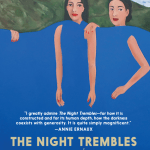
The Novel as Oracle and the Voice of Women Writers: Nadia Terranova’s “The Night Trembles,” Translated from Italian by Ann Goldstein
Nadia Terranova’s 2022 novel “The Night Trembles” (Trema la notte), translated in English by Ann Goldstein for Seven Stories Press (2025), gives voice to Barbara and Nicola, a young woman and a boy whose parallel plot lines develop against the background of a catastrophic natural disaster – the earthquake that decimated the cities of Messina and Reggio Calabria, on each side of the Strait of Messina, on December 28, 1908. Terranova, a contemporary Italian writer from Messina, has been mapping in her narratives the topographies of trauma – personal and collective – of her hometown and her native Sicily.

Where We Begin: Alba De Céspedes’ “There’s No Turning Back,” Translated from Italian by Ann Goldstein
“There’s No Turning Back” is an interesting early novel, and if one reads carefully one can detect the ways in which De Céspedes is searching for a voice. This is not to say that the novel is flawed, or even disappointing as an early novel. Instead, it gives the reader a profound introduction into the themes and style De Céspedes would later develop as a more mature writer.
“Like Grasping Nothing”: Revisiting Alessandro Baricco’s “Silk”
Above all, “Silk” is a novel that dwells in silences and negative spaces, an examination of unfulfilled desire and all that remains unspoken. Joncour’s fixation on the young concubine that captured his imagination remains unrealized, buried beneath clandestine love notes and quick glances. Joncour himself remains evasive throughout the novel, his identity as slippery and difficult to grasp as a swath of silk (back home in France he becomes “the Japanese,” not only a reference to his travels, but also a hint at the other hidden inside the self). It is in these empty spaces that this story of desire and identity begins to unfurl, as lush and heady as a children’s fable.
The Qualities of Silk in Ann Goldstein’s and Guido Waldman’s Translations of Alessandro Baricco’s “Silk”
“Silk” reads differently in each of its two English translations. The style of writing and the quality of the prose is where the two translations diverge. Goldstein has prioritized the “sparseness” of Baricco’s prose in a very literal sense. Her translation is minimal in its embellishments and its interpretation, rendering the novel into English in its most accurate, albeit plain, form. Waldman, on the other hand, has evidently prioritized the text’s beauty and lyricism.
Invisibility of the Foreign: The Double Life of Alessandro Baricco’s “Silk” in English Translation
Alessandro Barrico’s “Silk” is a story about the tension between Self and Other. Baricco’s main character Hervé Joncour travels repeatedly to Japan from his small, French town of LaVilleDieu in the 1860, to buy masses of silkworm eggs to replenish those at home struck by a silkworm-killing blight. Leaving his wife Hélène at home, he becomes secretly enamored with a young Japanese girl, whom he distinguishes for her eyes that “did not have an oriental slant” (19), a feature that immediately calls into question her otherness while nonetheless asserting her foreignness.

Geographies of Family Memory and Belonging: Marina Jarre’s “Return to Latvia,” Translated from Italian by Ann Goldstein
The case of the Italian author Marina Jarre (1925-2016) is unusual for the international literary market: her works are being simultaneously rediscovered in Italy and discovered in English translation. Jarre’s recently republished autobiography “I padri lontani” (1987, 2021) and its English translation “Distant Fathers” (2021) by Ann Goldstein have attracted wide attention.

Pains, Pens, and Poets: Elena Ferrante’s “In the Margins: On the Pleasures of Reading and Writing,” translated from Italian by Ann Goldstein
Part of what makes Ferrante’s work daring is her pursuit of a “female language,” nourished and emboldened by a female literary tradition, and capable of describing women’s experiences with truth and authenticity.

Gerda Taro’s Elusive Afterlives: Helena Janeczek’s “The Girl with the Leica,” Translated from Italian by Ann Goldstein
Pohorylle’s story is the inspiration for Helena Janeczek’s “The Girl with the Leica,” a complex, multivocal historical novel that is less a portrait of Gerda Taro than of her entire milieu: young, antifascist, bohemian, refugee, free-thinking, emancipated, and rife with short-lived romantic entanglements.

Turin’s Skies, Women’s Bodies, and Foreign Lands: Marina Jarre’s “Distant Fathers,” Translated from Italian by Ann Goldstein
The centrality of women’s experiences in current Italian fiction has drawn attention to previously neglected works. Although Jarre’s frankness about the body, from childhood to older age, is not shocking after Ferrante, it marked a new contribution to Italian literature in her time.

Elena Ferrante in a Global Context
This special issue was born out of the interweaving of our personal and professional stories, at the intersection of our different mother tongues and acquired languages, homelands, and disciplinary backgrounds. An Italian-Neapolitan scholar in Italy, a Bulgarian scholar in the United States, and a German scholar in the United Kingdom, we found a common ground through the study of Elena Ferrante and on the pages of a 2016 volume of the Italian scholarly journal Allegoria.

Reading Elena Ferrante in Bulgaria(n)
By Stiliana Milkova Last year I read Elena Ferrante’s new novel The Lying Life of Adults (La vita bugiarda degli adulti) in Bulgarian, in Ivo Yonkov’s translation from Italian. It was September 2020, it had just been released by Ferrante’s Bulgarian publisher, Colibri, and I was in Bulgaria myself. I went to Helikon, the largest […]

Mediterranean Crossings: Nadia Terranova’s “Farewell, Ghosts,” Translated from Italian by Ann Goldstein
A childhood home is an archive and a map. Nadia Terranova’s novel Farewell, Ghosts, in Ann Goldstein’s translation, summons the power of the house in order to dissect the relationship between self and space, memory and reality.

Framing by Fragmentation: Elena Ferrante’s “Incidental Inventions,” Translated from Italian by Ann Goldstein
By Stiliana Milkova The timing of Elena Ferrante’s Incidental Inventions is impeccable – it offers us an aperitivo before we can delve into her new novel scheduled to come out in English translation in June 2020. While we wait, we can flip leisurely through the pages of Incidental Inventions, translated from Italian by Ann Goldstein, and already in bookstores. […]

Thresholds and Mothers: Elsa Morante’s “Arturo’s Island,” Translated from Italian by Ann Goldstein
By Saskia Elizabeth Ziolkowski Elsa Morante’s Arturo’s Island: A Novel is an enchanting, complex work about a boy, Arturo, growing up on the island Procida. He swims, struggles to understand his father, adores his dog, falls in love, and eventually leaves home. His drama of adolescent feelings is both universally relatable and singular. Since he […]

Ann Goldstein on Ferrante Fever and what makes it into translation from the Italian
As Diana Thow and I were planning a session on Italian literature for the American Literary Translators Association conference, I happened to see translator of Elena Ferrante fame and New Yorker editor Ann Goldstein at the Turin Salone del Libro, where she was presenting a book of essays on Primo Levi and translation. [i] Goldstein, since she was […]