
Tag Archives: Poetry

Edge to Edge: Laura Marris In Conversation With John Taylor and Pierre Chappuis
By Laura Marris Some of us, if we are lucky enough, have witnessed it—the moment when a passing line of clouds tangles with the trees of a ridge, blurring the distinctions between branches and vapor, between landscape and sky. This thoughtful, sensitive volume offers the poetic equivalent of that process, a brush between two imaginative […]

On Dispersal and Translation: Golan Haji’s “A Tree Whose Name I Don’t Know,” Translated from Arabic by Stephen Watts and Golan Haji
By Ghada Mourad In an interview with Prairie Schooner, Golan Haji, a Kurdish Syrian poet, translator, and pathologist residing in France since 2011, states: “Translation is a process of changing places while you are in the same place […] It’s the stranger who comes to your house, is welcomed, is invited, and you know that […]

Everyday Illuminations: Gemma Gorga’s “Book of Minutes,” Translated from Catalan by Sharon Dolin
By Mary Ann Newman Unlike American poetry, Catalan poetry tends to shun the confessional or the directly personal. To revive a Lacanian phrase, Catalan poetry is always already political. A language and a literature that suffered continual interruptions owing to lost wars and various repressions—the 1714 War of Succession, the 1923 dictatorship of Primo de […]

Clinical Erotics in Luis Panini’s “Destruction of the Lover,” Translated from Spanish by Lawrence Schimel
This month, in memory of our contributor Professor Jed Deppman who founded the Oberlin College Translation Symposium, instituted a literary translation minor, and taught courses in literary translation and comparative literature, we are featuring three reviews by Oberlin College Comparative Literature graduates and students, taught and trained by Professor Deppman and other Oberlin College faculty. Professor […]

It’s a Wonderful Death: Hilda Hilst’s “Of Death. Minimal Odes,” translated from Portuguese by Laura Cesarco Eglin
By Alessandro Mondelli In Of Death. Minimal Odes, Brazilian poet Hilda Hilst imagines death not only as the absence of life or as life’s negation, but also as a productive force that imbues life with a wide yet nuanced palette of affects. Hilst, recognized in Brazil as a seminal writer, poet, and playwright of twentieth-century […]

“Free falling through the subconscious”: Pablo Neruda’s “venture of the infinite man,” translated from Spanish by Jessica Powell
Reviewed by Arielle Avraham Pablo Neruda (1904-1973) remains one of the best-known South American poets of the 20th century, with copies of his most famous books selling in the millions, and two biographies published about him. His life is the stuff of legend. Born in a rural town in Chile, he began writing poetry as […]

A Scrapbook of “Memorial Clippings”: “My Lai” by Carmen Berenguer, translated from Spanish by Liz Henry
Reviewed by Kelsi Vanada It feels as though the pages of Chilean poet Carmen Berenguer’s My Lai, translated into English by Liz Henry, originated in a scrapbook or journal kept over many years—picked up, loose pages shaken out, and gathered up again quickly and out of order. This sensation is augmented by the inclusion of […]

Catharsis, Grief, and the Beauty of Nature: Less Like a Dove By Agi Mishol, Translated by Joanna Chen
Reviewed by Gwen Ackerman Agi Mishol is as one of Israel’s most beloved poets. The recipient of numerous awards including the Israeli Prime Minister’s Prize, the Yehuda Amichai Prize for Hebrew Poetry, and the Lerici-Pea Prize in Italy, she has taught in programs and schools throughout Israel. Her work has been translated into several languages, […]

Transparent Hours: Eunice Odio’s Territory of Dawn. Selected Poems, Translated by Keith Ekiss, Sonia P. Ticas, and Mauricio Espinoza
Reviewed by Jessica Sequeira It seems a terrible irony: a poet who primarily dedicated her work to a Beloved, one whose verses seem written with joy and melancholy rather than malice, is born with a surname that means hate. But no, already it’s a mistake to start from signification. Let’s think into this a different […]
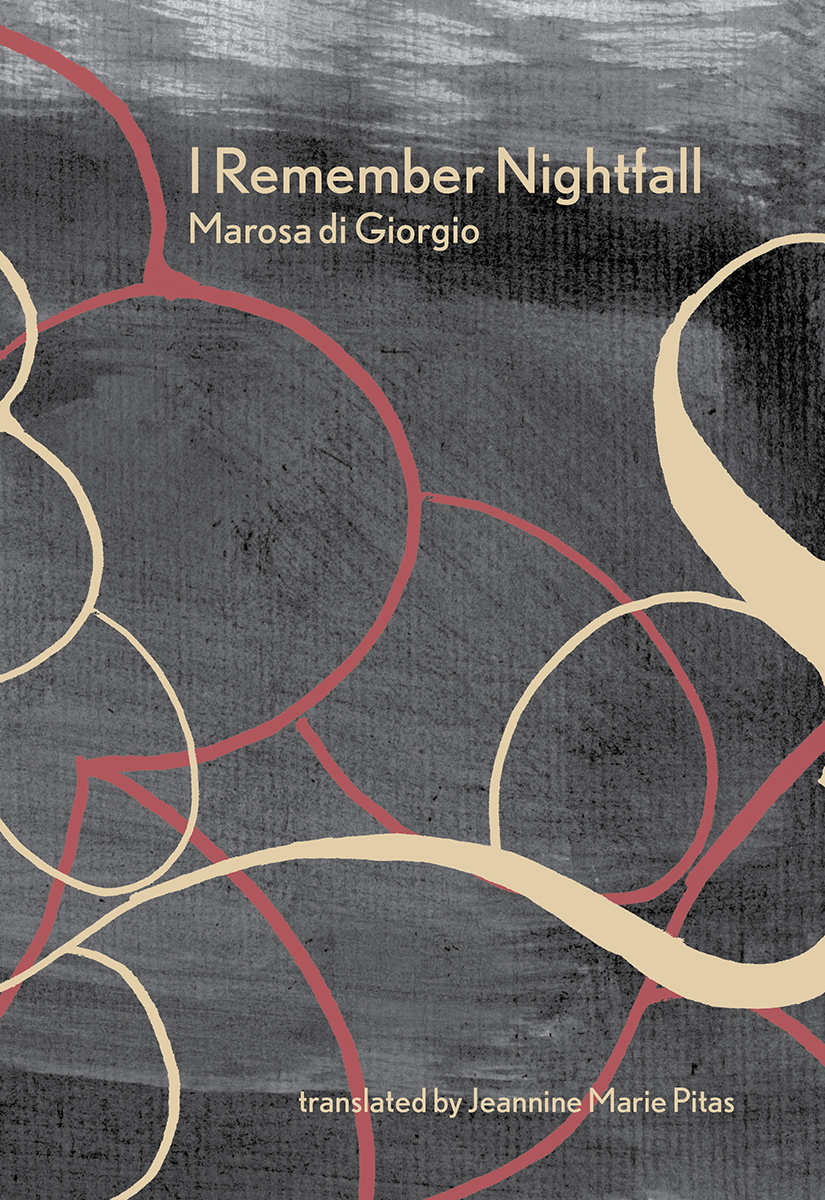
Sugar castles: I Remember Nightfall by Marosa di Giorgio, translated by Jeannine Marie Pitas
Reviewed by Jessica Sequeira The poems of Uruguayan writer Marosa di Giorgio (1932 – 2004) are luscious, dark and gorgeous — but they also leave the reader with a sickly taste, an effect similar to that following the rapid consumption of a bag of sticky sweets, gulped down one after another while in thrall to […]

Hothouse Flower: Olvido García Valdés’s And We Were All Alive, translated by Catherine Hammond
Reviewed by Jessica Sequeira “There were those who compared her to Santa Teresa, others who said she was too serious, even sullen, and people who swore her pride was chilling to those who met her,” wrote Roberto Bolaño of Olvido García Valdés. When he read her work, however, it “dazzled [him] the way that only […]

“island under our skin”: tasks by Víctor Rodríguez Núñez, translated by Katherine M. Hedeen
Reviewed by Kelsi Vanada I often find myself explaining my desire to translate by expressing that it is an inherently collaborative project, one in which my voice gets to support another’s. tasks, which was longlisted for the 2017 Best Translated Book Award, is the most recent, luminous product of years of collaboration between poet Víctor […]

Kernel of the Future: Hirato Renkichi’s Spiral Staircase, Translated by Sho Sugita
Reviewed by Jordan A. Y. Smith Spiral Staircase, an engaging collection of poems and works by the dynamo of Japanese futurism, Hirato Renkichi, ably fulfills the translator and editor’s declared mission: “providing English-language readers a focused survey of Hirato’s life-long literary output” (8). Considering the brevity of his life (1893-1922), Hirato accomplished much, experimenting with […]

Forrest Gander on editing untranslatable poet Yoshimasu Gozo
Yoshimasu Gozo is a one-of-a-kind artist. While he’s usually referred to as a poet, such a categorization almost always comes with some sort of qualification. His work is often called “unconventional” or “unorthodox.” Others stress that his poetry draws heavily from performance, music, and/or multimedia art. In a word, he writes the sort of poetry that’s […]

Invisible Currents: Kyn Taniya’s Radio, Translated by David Shook
Reviewed by Brian McLaughlin As Arthur C. Clarke famously stated, “Any sufficiently advanced technology is indistinguishable from magic,” a claim which has obviously assumed the status of proverb, not only in science fiction but also in any vein of cultural criticism. Yet, as early as 1924, Mexican poet Kyn Taniya was already demonstrating the truth […]